Amazon FBA Fees Explained
- Get link
- X
- Other Apps
Amazon FBA is one of the most powerful fulfilment options for UK sellers — but the real question is always the same: how much does it actually cost in 2025? Fees can eat into margins quickly if you don’t fully understand them. Between fulfilment costs, storage charges, prep fees, and extra add-ons, it’s easy to underestimate what you’ll pay.
In this guide, I’ll break down every type of Amazon FBA fee in the UK for 2025, explain how they’re calculated, and share practical ways to keep costs under control.
What is Amazon FBA?
Fulfilment by Amazon (FBA) is where Amazon stores your products, picks, packs, and ships orders on your behalf. You send your inventory to Amazon fulfilment centres, and they handle the logistics.
The benefit? Customers see the Prime badge, delivery is faster, and you don’t need to manage your own warehouse.
But it comes at a price. Amazon charges a wide range of fees depending on:
- Product size and weight
- Storage duration
- Special handling or prep requirements
- Where and how you sell
Benefits of Using Amazon FBA
Amazon FBA isn’t cheap, but it does bring real advantages that often justify the fees:
- Prime eligibility – Products get the Prime badge, which boosts visibility and conversion rates.
- Logistics handled – No need to manage storage, picking, packing, or shipping.
- Customer trust – Faster shipping and Amazon’s reputation increase buyer confidence.
- Returns management – Amazon processes returns (though, of course, this adds costs sellers need to factor in).
These benefits explain why thousands of UK sellers rely on FBA — but only if the math works out.
Full Breakdown of Amazon FBA Fees (UK 2025)
Amazon splits fees into several categories. Here’s a full look at each one:
1. Fulfilment Fees (per-unit fees)
This is the cost Amazon charges every time it picks, packs, and ships one of your units. Fees depend on product size and weight.
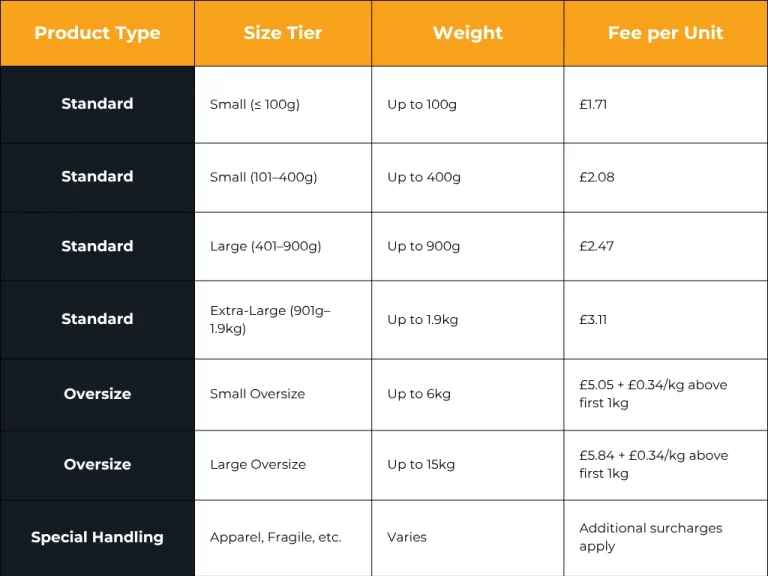
3. Amazon FBA Prep Service Fees
If your items aren’t labelled, poly-bagged, bubble-wrapped, or otherwise prepared according to Amazon’s requirements, they’ll charge you for it.

Prep services are one of the most overlooked costs. Many sellers find using a 3PL prep service more cost-effective than relying on Amazon’s charges.
4. Removal & Disposal Fees
If stock isn’t selling, you may request Amazon to remove or dispose of it.
- Removal fee: £0.25 – £0.50 per unit (depending on size/weight)
- Disposal fee: £0.15 – £0.30 per unit
5. Returns Processing Fees
For some product categories (especially apparel), Amazon charges for handling returns. This cost is often overlooked but can chip away at margins, particularly in high-return categories.
6. Other Potential Fees
- Overweight / oversize surcharge – For products that exceed thresholds.
- Unplanned prep fee – If items arrive at fulfilment centres incorrectly prepared.
- Inventory placement service – Optional, but costs extra if you want Amazon to distribute stock across warehouses.
Using the Amazon FBA Fees Calculator (UK)
Amazon provides a free calculator that lets you compare FBA fees against Fulfilment by Merchant (FBM).
When using the FBA fees calculator UK sellers should:
- Enter the product ASIN or size/weight
- Compare FBA fees vs FBM costs
- Factor in shipping costs, storage fees, and prep service charges
- Consider sales velocity (slow-moving items increase storage fees)
The calculator is useful, but many sellers still underestimate costs like long-term storage and returns handling.
Strategies to Reduce Amazon FBA Fees
You can’t avoid FBA fees, but you can reduce them.
- Choose the right products – Low-margin, oversized, or slow-moving products are fee traps.
- Optimise packaging – Reducing product dimensions by even a few centimetres can push an item into a lower fee bracket.
- Use a 3PL for prep – Third-party fulfilment partners often prep items more cost-effectively than Amazon.
- Watch your storage times – Rotate stock quickly to avoid long-term storage surcharges.
Diversify beyond Amazon – Relying solely on FBA can be risky. Expanding into Shopify or TikTok Shop fulfilment spreads costs more efficiently.
Tired of FBA fees? SFP is a great alternative. SFP allows sellers to display the Prime badge and offer the same fast delivery promise as FBA, but without being locked into Amazon’s storage and fulfilment fees. Instead, you handle fulfilment yourself or partner with a 3PL that meets Amazon’s strict performance standards. For many businesses, this creates the perfect balance — enjoying the sales boost of Prime while keeping costs under tighter control.

How PackPro Can Help With Amazon FBA Fulfilment
Managing Amazon FBA fees takes constant attention. From storage costs to unplanned prep charges, it’s easy to let profitability slip. That’s where PackPro helps.
We support Amazon sellers by:
- Lowering prep costs – Our FBA prep services reduce per-unit costs compared with Amazon’s rates.
- Avoiding storage surcharges – Store bulk stock with us at competitive rates and drip-feed into Amazon when needed.
- Optimising fulfilment models – Whether you choose FBA vs FBM, or Seller Fulfilled Prime, we’ll help you understand the real cost per order.
- Diversifying fulfilment – If Amazon isn’t your only channel, we also integrate with Shopify fulfilment, eBay fulfilment, and TikTok Shop fulfilment.
Working with PackPro means you can scale your Amazon business without losing control of margins.
Conclusion
Amazon FBA can transform your sales — but it comes at a price. Between fulfilment fees, storage charges, prep costs, and long-term inventory surcharges, fees can quickly add up if you don’t stay on top of them.
Understanding the full breakdown and making smart choices about packaging, product selection, and prep services ensures you stay profitable while still enjoying the benefits of Prime eligibility.
- Get link
- X
- Other Apps


Comments
Post a Comment